Increasing youth voice in the design of active spaces.
Sport New Zealand Ihi Aotearoa cares deeply about creating better outcomes for rangatahi in Aotearoa and the role physical activity can play in their development and well-being. To contribute to these outcomes, we supported Sport NZ to showcase effective co-design practices so more young people have the opportunity to shape active spaces in their communities.
Challenges.
Currently, young people in New Zealand don’t often have the opportunity to shape the physical spaces in their communities. With young people’s participation levels in physical activity typically dropping off as they enter adulthood, Sport NZ saw an opportunity for rangatahi to have more of a say in what active spaces look and feel like, to better reflect their needs.
To do this, Sport NZ approached DNA to help them showcase how some communities had co-designed active spaces with rangatahi (such as skate parks and playgrounds), and create guidance for others to do the same.
Activities.
To better understand the realities of co-designing spaces and places with rangatahi, we talked to Shore Junction, Porirua City Council, Whanake Youth, and Tairāwhiti Adventure Trust about their experiences of involving young people in the design of their spatial projects.
From those conversations, we developed case studies showcasing the process they followed and what they learnt from the experience. We used their insights to create co-design guidance, and tested this back with a range of organisations to understand if it was practical and useful. Finally, we used their feedback to refine the content, which Sport NZ further developed and has now shared publicly for anyone to use.
Throughout this process, we partnered with youth development organisation the Shift Foundation who contributed their expertise in engaging with young people. Read more about our partnership with Shift here.
Solution.
The resulting co-design guidelines provide practical ways for local Council and Regional Sports Trust staff to engage with young people.
While 'co-design' and 'consultation' can often be confused, the key difference is the level of agency young people have over decision-making processes.
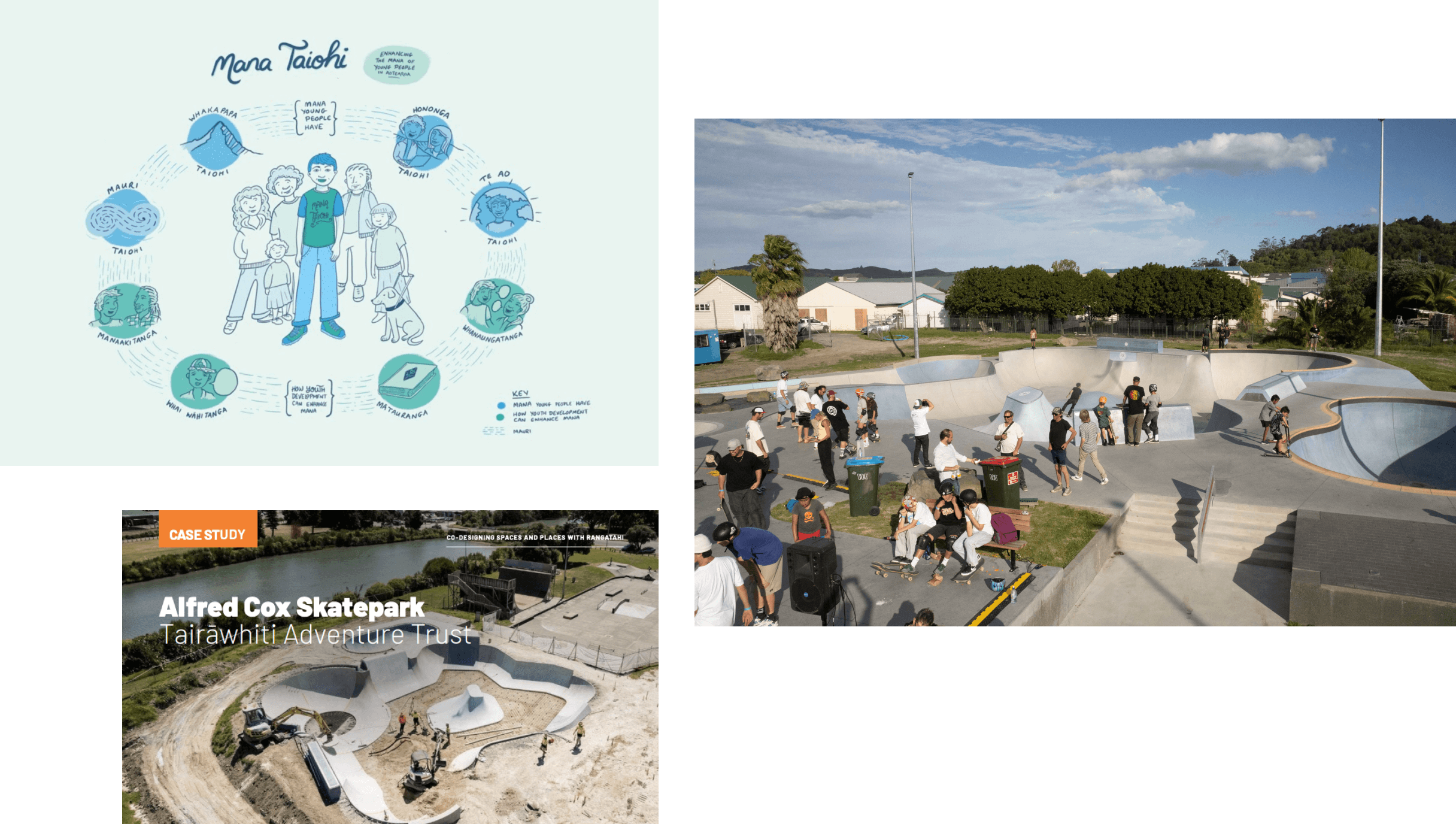
We aimed to differentiate this using the youth development framework ‘Mana Taiohi’ as a foundation for co-design activities. Mana Taiohi is a set of principles developed by New Zealands’ peak youth development body that acknowledges young people's mana and how we can work with rangatahi to enhance their mana.
The Mana Taiohi principles include:
-
Whanaungatanga: Build and sustain quality relationships as a foundation to belonging
-
Manaakitanga: Create safe spaces where young people feel accepted, included, and valued
-
Whai Wāhitanga: Give young people space to assume agency and take responsibility
-
Mātauranga: Empower young people with useful, timely, and meaningful information.
These principles were complemented by examples of what they can look like across the full life-span of a spatial project; from scoping to designing, building and maintaining that space. Critically, these principles and guidance could also be applied to many other sectors to better engage with rangatahi.
Impact.
As the guidance has only just been launched, it will take time to see the full impact of this work. In the short term, it has helped to spark conversations across Sport NZ about the role of youth voice and engagement when designing physical activity solutions.
“It's been really exciting for me to see the Mana Taiohi principles applied to something other than physical activity delivery, and it's great to have many different areas of Sport NZ now talking about taking a youth development approach to our work with young people.”
Chloe Bishop, Active Recreation Consultant, Sport New Zealand
Sport New Zealand plans to share and develop this guidance with their regional partners across Aotearoa, including Regional Sports Trusts and local councils.
Ultimately, the aspiration is that more community facilities across Aotearoa reflect the needs of our young people so they can be active in ways that are meaningful and relevant to them.
—
Photography credit: Surely Skate
Client: Sport New Zealand Ihi Aotearoa
Project: Rangatahi Co-design Guidelines
Timeline: 3 months
Deliverable: Experience Research / Co-design Guidelines